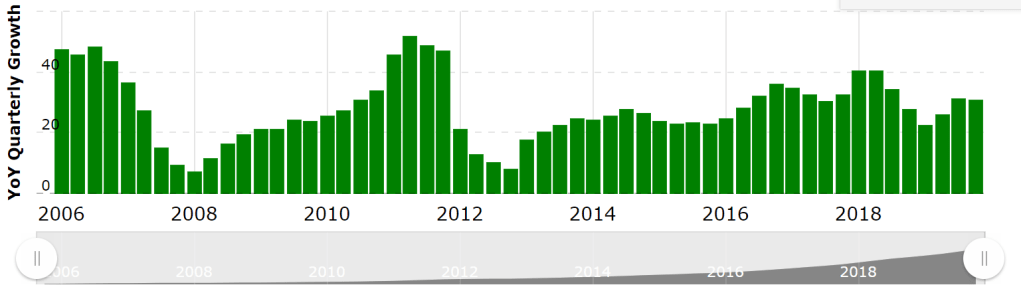
Netflix, founded in 1997 in America by Marc Randolph and Reed Hastings, is the global leading streaming entertainment service. With over 167 million paid memberships in over 190 countries, Netflix has seen substantial growth to its valuation, profits, reputation and user population continuously. Figures on Macrotrends showed that Netflix’s revenues rose 27.62% year-over-year (y-o-y) to 20.156 billion dollars in 2019. Forbes (2019) believed Netflix’s substantial international rise would continue despite facing fierce competitions from other content providers like Hulu.
Initially, at the start of its foundation, Netflix made its first money in the market by renting out DVDs by mails. In 1999, it debuted a subscription service, which offered unlimited DVD rentals for paid users with a relatively low price per month. Such service made Netflix gain over 200 thousand subscribers in the first year. With continuously accumulative members database combined with its forecasting on digital economy, Netflix formed its digital business model based on the digital technologies including Artificial Intelligence (AI) and Big Data Analysis (BDA) and evolved into a online service-based model which triggered its greater success in the later digital economy era (Marjoleign, 2019).
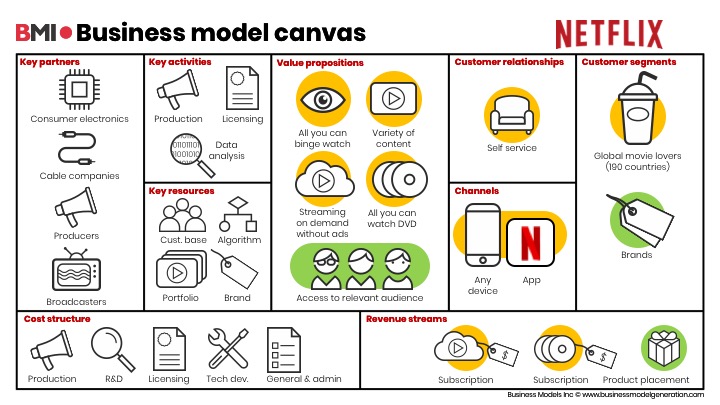
Actually, how Netflix’s digital business model facilitated its success can be summarized in three aspects. Firstly, recognizing the value of the digital asset and collecting user data. With increasing subscribers, Netflix had built an extensive members database.
Secondly, the use of AI and BDA finds data insight from data assets to judge users’ needs, which is also regarded as the critical point of Netflix’s successful digital transition. Based on tracking and analyzing users’ watching history, duration, viewing behaviours including pause, fast forward and playback and individual ratings of episodes, searching history, and comments, users’ needs and preferences are predictable. If a subscriber shows preference to an exact topic, Netflix can recommend other related videos for himself, and such service performed better and more efficient outweigh self-searching. For me, its recommendations are positive and being a part of my viewing habits. I have found numerous videos that I favours among them. Nowadays, I prefer to select from its recommendations first instead of searching by myself while using Netflix.
Finally, the logic of the subscriber economy shifted the focus of the business model from selling goods to services and experience. Through this method, greater relationships and loyalty with customers replaced once simple transactions. A simple definition is a business model in which a well-run business can lock in 70% of its revenues at the start of each year because at least 70% of its subscribers will continue to pay for its services in the New Year. The economic logic of subscribers is not a new concept. Newspapers and magazines have been relying on their subscribers for more than a century, and HBO, a cable movie channel that does not run any commercials at all, gets most of its revenue from subscribers. Understanding subscribers, locking in subscribers, and enhancing subscriber stickiness have become the most important relationships in the business model of the subscriber economy.
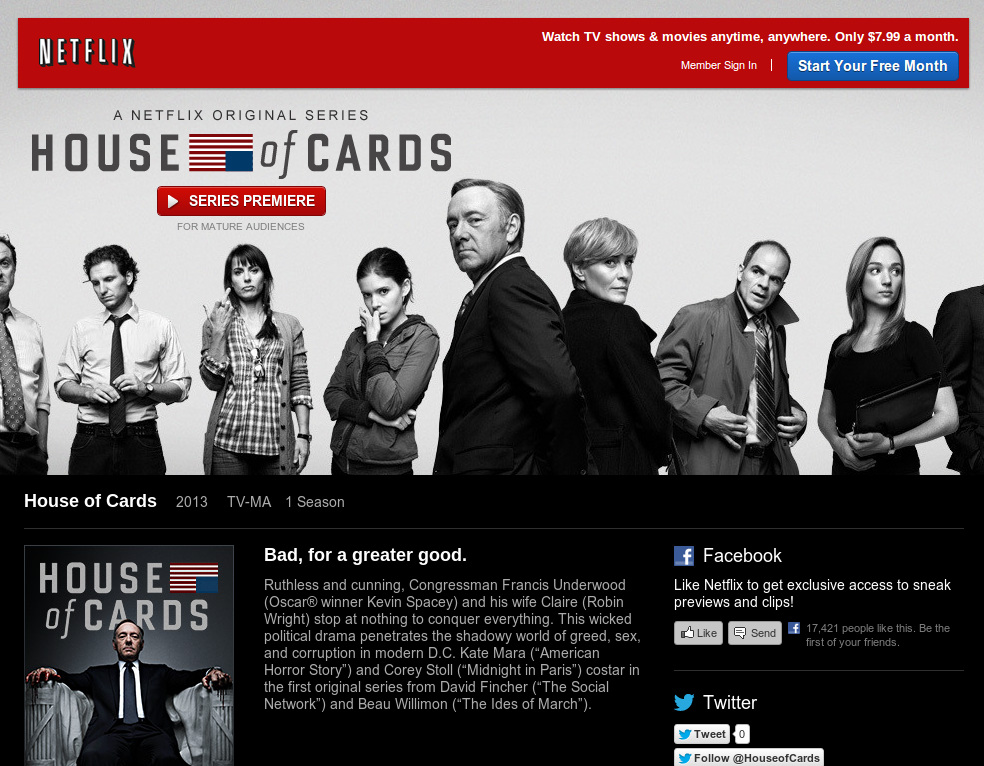
The success of filming House of Cards can also be viewed as the epitome of Netflix’s successful digital business model. After analyzing the viewing habits of a large number of users, it was found that a large number of users liked the original BBC series House of Cards (the American version of House of Cards is a remake of the BBC series), and many users watched the series over and over again, and could not stop watching it. These behaviours in Netflix’s view are the direct expression of users’ preferences. In a related development, Netflix has found that fans of the BBC version of House of Cards are also keen on movies starring actor Kevin Spacey and are keen on director David Fincher of the Social Network. With big data and algorithms to tease out the scripts, actors and directors that viewers approve of, Netflix’s top brass decided that a show packed with all three was worth a bet and that it was a big bet. Apparently, Netflix’s gamble has been a commercial success and an artistic coup for critics. Thanks to House of Cards, Netflix earned multiple Emmy nominations in just six months, eventually taking home an Emmy and a golden globe. By contrast, HBO waited 25 years for its first Emmy nomination.
References:
Great Speculations. (2019). A Closer Look At Netflix’s Valuation. Forbes. Retrieved on 4th March 2020 from: https://www.forbes.com/sites/greatspeculations/2019/03/26/a-closer-look-at-netflixs-valuation-2/#17c6231028c7
Marjoleign., O. (2018). Netflix: How a DVD rental company changed the way we spend our free time. BMI. Retrieved on 4th March 2020 from: https://www.businessmodelsinc.com/exponential-business-model/netflix/
Netflix Media Center. (2020). Retrieved on 4th March 2020 from: https://media.netflix.com/en/about-netflix
Netflix Revenue 2006-2019 | NFLX. Macrotrends. Retrieved on 4th March 2020 from: https://www.macrotrends.net/stocks/charts/NFLX/netflix/revenue
 站点标题
站点标题 
Surprise to me that I never know Netflix would track and analyze users’ watching habit, which include playback, pause or fast forward! I thought they only recommend viewers base on the type of the dramas or movies they had been watched.
Here is an article (Siddiqi, 2019) illustrated that how Netflix use social media to interact with audiences, they usually make funny dialogues and votes in order to communicate with their target audiences. Just as you mention in your post, they make good use of resources to understand and analyze what is suitable for every viewer. This make people want to keep subscribing and using Netflix instead choosing other platforms.
在 Medium.com 上查看
赞赞
Hey, Yaoqi.
As a fan of American TV series, I can’t be more familiar with Netflix. I am fascinated by the House of Cards, the Crown, BoJack Horseman, and Narcos produced and distributed by Netflix. After reading your blog, I also have a better understanding of this digital business model based on subscriptions.
As a student of Data Science with Business, I once did data analysis on TV series. Amazon pioneered in using data analysis for television production, a series about senates called “Alpha House” was produced based on users’ behaviors, such as when do users pause, which clips are repeatedly played, on 8 different TV series and was then scored only 7.5 with 4000 votes on IMDb. Meanwhile, Netflix decided to produce a series also about senates but proceeded with data from different perspectives. The data includes how those shows are rated by users, who are the most appraised performers, and what stories do people like. “House of Cards” was thus produced and scored 8.9 with 461,919 votes on IMDb.
赞赞
I knew Netflix has been using big data to recommend their subscribers on what to watch next and I knew they have been analysing the data that they collected from their users to help making decision on what to produce next. I do not mind my watch history to be analysed because I think it contributes to better-quality entertainment. However, I hate them proving me recommendations. I found those recommendations are not intelligent enough, and sometimes irrelevant to my interest. As a film student, I watch a wide range of things; I always want to jump outside of the box, and challenge myself to appreciate film art in all genres. I enjoy watching films made by a variety of nations, not just singularly the one that I have recently watched. I strongly recommend that Netflix could add a button for switching-off the recommendation function…
赞赞
I really like your article. It is concise and clear. Business model to b or to c is the key to content quality. If to b, then it is the audience rating that determines the advertising revenue. The high audience rating must satisfy the greatest common divisor. Crowd-pleasing leads to conservative content strategy. To c, on the other hand, charges a membership fee that is user-oriented and gives consumers value for money. As you said, the success of “House of Cards” can also be seen as a microcosm of the success of Netflix’s digital business model. Emmys mean great prestige. They attract more creative talent and enhance brand recognition. I always remember Hastings saying, “our core strategy is to focus on content. If we copy other people’s models, we will never succeed.”
赞赞
I like your article very much. It is concise and clear. Business model to b or to c is the key to content quality. If to b, then it is the audience rating that determines the advertising revenue. The high audience rating must satisfy the greatest common divisor. Crowd-pleasing leads to conservative content strategy. To c, on the other hand, charges a membership fee that is user-oriented and gives consumers value for money. As you said, the success of “house of CARDS” can also be seen as a microcosm of the success of Netflix’s digital business model. Emmys mean great prestige. They attract more creative talent and enhance brand recognition. I always remember Hastings saying, “our core strategy is to focus on content. If we copy other people’s models, we will never succeed.”
赞赞